- Home
- About Us
- Orthopaedics / Joint Replacement
- Joint Replacement
- Sports Injury / Arthroscopy
- Trauma Fracture and Management
- Knee
- Hip
- Spine
- Shoulder & Humerus
- Elbow & Radius + Ulna
- Wrist & Hand
- Ankle & Foot Care
- Arthritis Management
- Paediatric Orthopaedics
- Pelvis & Acetabulum Fractures
- General Surgery
- Obstetrics & Gynaecology
- General Medicine
- Dermatology & Aesthetics
- ENT
- Contact Us

Wrist & Hand – Joint Replacement
Wrist and hand joint replacement, also known as arthroplasty, is a surgical procedure in which damaged or arthritic joints are replaced with artificial implants to relieve pain and restore motion and function. This procedure is typically considered for patients with severe arthritis, joint deformities, or post-traumatic joint damage that limits hand or wrist function and affects quality of life.
Joint replacement is most commonly performed in the wrist, knuckle joints (MCP), and finger joints (PIP).
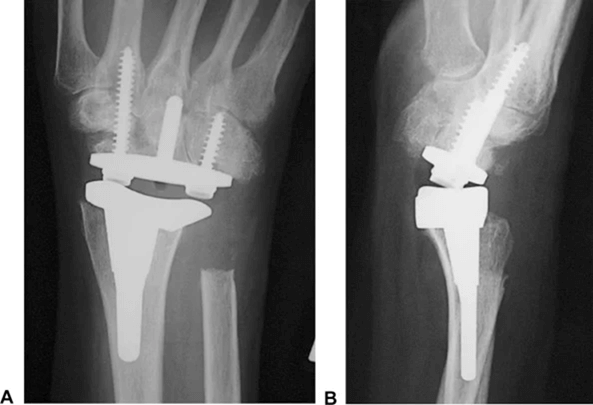
Common Types of Wrist & Hand Joint Replacements:
- Wrist Joint Replacement (Total Wrist Arthroplasty): Replaces the damaged wrist bones with a metal and plastic prosthesis to restore flexibility and motion.
- MCP Joint Replacement (Knuckles): Commonly performed in rheumatoid arthritis to reduce pain and correct deformities of the finger knuckles.
- PIP Joint Replacement (Middle Finger Joints): Helps restore finger bending and function while reducing pain.
Procedure Overview:
- Evaluation: Includes physical exam, X-rays or MRI, and functional assessment of the hand or wrist.
- Surgery: The damaged joint surfaces are removed and replaced with implants made of metal, ceramic, or medical-grade plastic.
- Postoperative Recovery: The hand is supported in a splint or cast. Rehabilitation begins gradually to restore movement and strength.
Do’s After Wrist/Hand Joint Replacement
- Follow all post-operative instructions carefully
- Keep the hand elevated and clean to minimize swelling
- Wear the splint or brace as advised
- Start physiotherapy and hand therapy as prescribed
- Attend regular follow-up visits and X-rays to check implant position
- Use adaptive tools (if needed) to reduce joint strain
Don’ts After Wrist/Hand Joint Replacement
- Don’t lift heavy weights or strain the operated hand
- Avoid repetitive forceful gripping until fully healed
- Do not skip physical therapy—it’s key to full recovery
- Don’t smoke or drink excessively—it slows healing
- Avoid wetting the surgical site until your doctor permits
- Don’t ignore signs of infection or unusual pain