- Home
- About Us
- Orthopaedics / Joint Replacement
- Joint Replacement
- Sports Injury / Arthroscopy
- Trauma Fracture and Management
- Knee
- Hip
- Spine
- Shoulder & Humerus
- Elbow & Radius + Ulna
- Wrist & Hand
- Ankle & Foot Care
- Arthritis Management
- Paediatric Orthopaedics
- Pelvis & Acetabulum Fractures
- General Surgery
- Obstetrics & Gynaecology
- General Medicine
- Dermatology & Aesthetics
- ENT
- Contact Us

Elbow – Arthroscopy
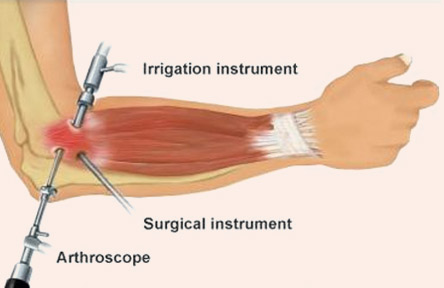
Elbow arthroscopy is a minimally invasive surgical procedure that allows orthopedic surgeons to examine and treat problems inside the elbow joint using a small camera (arthroscope) and specialized instruments inserted through tiny incisions. It is commonly used to diagnose and treat elbow pain, stiffness, cartilage damage, and loose bone fragments without the need for large open surgery.
This technique offers faster recovery, less pain, and minimal scarring, making it a preferred option for many elbow joint conditions.
When is Elbow Arthroscopy Recommended?
- Elbow stiffness or locking
- Loose bodies (bone or cartilage fragments)
- Tennis elbow (lateral epicondylitis) not responding to therapy
- Osteoarthritis or post-traumatic arthritis
- Synovitis (inflammation of joint lining)
- Early-stage rheumatoid arthritis
- Elbow impingement or instability
- Evaluation and treatment of cartilage damage or fractures
Procedure Overview:
- Preoperative Evaluation: Includes physical examination and imaging such as X-rays or MRI to plan the arthroscopy.
- Anesthesia: Typically done under general or regional anesthesia.
- Arthroscopic Surgery: Small incisions are made around the elbow to insert the arthroscope and instruments. The surgeon views the joint on a screen and performs repairs such as:
- Removing loose bodies or bone spurs
- Smoothing cartilage damage
- Releasing tight soft tissues
- Treating inflammation
- Closure & Recovery: The incisions are closed with small sutures or tapes. Patients usually go home the same day.
Do’s After Elbow Arthroscopy
- Keep the arm elevated and apply ice to reduce swelling
- Follow wound care instructions to prevent infection
- Begin gentle range-of-motion exercises as advised
- Take medications as prescribed
- Attend all follow-up visits and physiotherapy sessions
- Use a sling temporarily if recommended
Don’ts After Elbow Arthroscopy
- Avoid lifting or forceful movements with the elbow initially
- Do not soak or wet the surgical area until cleared by your doctor
- Don’t skip prescribed rehab exercises
- Avoid smoking and alcohol during recovery
- Don’t ignore signs of infection (redness, warmth, drainage, or fever)