- Home
- About Us
- Orthopaedics / Joint Replacement
- Joint Replacement
- Sports Injury / Arthroscopy
- Trauma Fracture and Management
- Knee
- Hip
- Spine
- Shoulder & Humerus
- Elbow & Radius + Ulna
- Wrist & Hand
- Ankle & Foot Care
- Arthritis Management
- Paediatric Orthopaedics
- Pelvis & Acetabulum Fractures
- General Surgery
- Obstetrics & Gynaecology
- General Medicine
- Dermatology & Aesthetics
- ENT
- Contact Us

Wrist & Hand – Arthroscopy
Wrist and hand arthroscopy is a minimally invasive surgical procedure that allows orthopedic surgeons to view, diagnose, and treat joint problems using a small camera (arthroscope) inserted through tiny incisions. It provides a clear view of the bones, cartilage, ligaments, and tendons inside the wrist or small joints of the hand, enabling accurate diagnosis and targeted treatment.
This advanced technique is commonly used for treating chronic pain, ligament injuries, arthritis, and wrist instability, with less tissue damage, faster healing, and minimal scarring compared to open surgery.
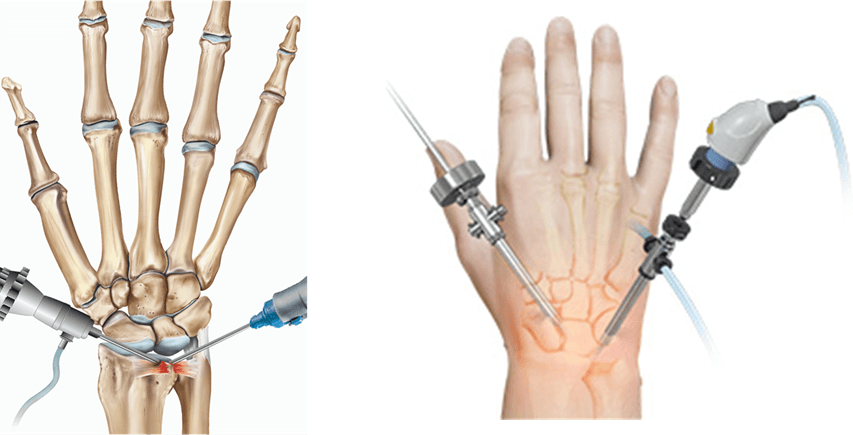
Procedure Overview:
- Preoperative Assessment:
Includes imaging (X-ray, MRI, CT) and physical evaluation to plan the arthroscopy. - Anesthesia: Performed under regional (nerve block) or general anesthesia.
- Arthroscopy: Small incisions (portals) are made to insert the arthroscope and surgical tools. The surgeon can:
Visualize and diagnose joint damage- Repair torn ligaments
- Remove inflamed tissue, loose cartilage, or cysts
- Smooth joint surfaces or remove debris
- Recovery: Since the procedure is minimally invasive, patients often return home the same day. Recovery time varies depending on the condition treated.
Do’s After Wrist/Hand Arthroscopy
- Keep the surgical area elevated to reduce swelling
- Follow post-operative instructions on dressing and hygiene
- Perform gentle hand and finger movements (if allowed)
- Start physiotherapy as advised to regain
- Use a wrist brace if prescribed
- Attend follow-up appointments for monitoring recovery
Don’ts After Wrist/Hand Arthroscopy
- Avoid lifting heavy objects or strenuous hand activities
- Don’t wet the surgical site until cleared by your doctor
- Do not ignore signs of infection (redness, warmth, pus, fever)
- Don’t skip prescribed physiotherapy exercises
- Avoid smoking and alcohol during recovery—they delay healing
Advantages of Wrist & Hand Arthroscopy:
- Minimally invasive with tiny incisions
- Less pain and swelling compared to open surgery
- Quicker return to daily activities
- Precise diagnosis and
- Better cosmetic outcome with minimal scarring