- Home
- About Us
- Orthopaedics / Joint Replacement
- Joint Replacement
- Sports Injury / Arthroscopy
- Trauma Fracture and Management
- Knee
- Hip
- Spine
- Shoulder & Humerus
- Elbow & Radius + Ulna
- Wrist & Hand
- Ankle & Foot Care
- Arthritis Management
- Paediatric Orthopaedics
- Pelvis & Acetabulum Fractures
- General Surgery
- Obstetrics & Gynaecology
- General Medicine
- Dermatology & Aesthetics
- ENT
- Contact Us

Vertebroplasty
Vertebroplasty is a minimally invasive procedure used to treat spinal compression fractures, especially those caused by osteoporosis, trauma, or tumors. It involves the injection of a medical-grade bone cement into the fractured vertebra to stabilize the spine, relieve pain, and prevent further collapse.
This procedure is most effective in osteoporotic vertebral fractures and helps patients return to normal activities quickly with minimal downtime.
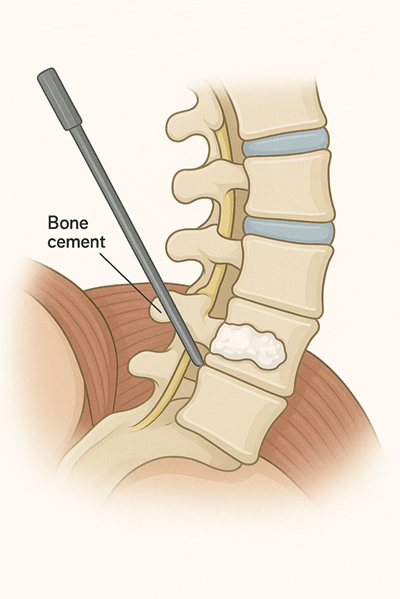
Procedure Overview:
- Imaging (MRI or CT) confirms the location and nature of the fracture.
- The procedure is done under local anesthesia with sedation or light general anesthesia.
- A small needle is guided through the skin into the fractured vertebra.
- Bone cement is injected to fill the cracks and stabilize the bone.
- The cement hardens within minutes, providing immediate structural support.
- The entire procedure usually takes 30–60 minutes, and many patients go home the same day.
Benefits of Vertebroplasty:
- Rapid and effective pain reliefImmediate spine stability
- Minimally invasive with no large incisions
- Short recovery time – return to daily activities quickly
- Helps prevent further collapse of the fractured vertebra
- Suitable for elderly or high-risk patients who can’t undergo open surgery
Do’s After Vertebroplasty
- Rest for a few hours after the procedure
- Resume light activities within 1–2 days
- Take prescribed medications and maintain hydration
- Perform back-strengthening exercises as advised
- Follow up with your doctor for imaging and osteoporosis management
Don’ts After Vertebroplasty
- Avoid heavy lifting or strenuous activities for a few weeks
- Don’t ignore new or worsening back pain
- Avoid bending or twisting sharply during early recovery
- Don’t skip follow-up appointments or bone health evaluation
- Avoid smoking and alcohol, which weaken bones