- Home
- About Us
- Orthopaedics / Joint Replacement
- Joint Replacement
- Sports Injury / Arthroscopy
- Trauma Fracture and Management
- Knee
- Hip
- Spine
- Shoulder & Humerus
- Elbow & Radius + Ulna
- Wrist & Hand
- Ankle & Foot Care
- Arthritis Management
- Paediatric Orthopaedics
- Pelvis & Acetabulum Fractures
- General Surgery
- Obstetrics & Gynaecology
- General Medicine
- Dermatology & Aesthetics
- ENT
- Contact Us

Wrist & Hand – Fusion
Wrist and hand fusion, medically known as arthrodesis, is a surgical procedure where two or more bones in the hand or wrist are permanently joined (fused) to form a single, solid bone. This is typically done to eliminate pain, correct deformity, or stabilize a severely damaged joint that no longer functions properly due to arthritis, trauma, or failed previous surgeries.
While fusion removes motion in the affected joint, it provides a strong, pain-free, and stable structure, allowing the hand or wrist to perform weight-bearing and functional tasks more effectively.
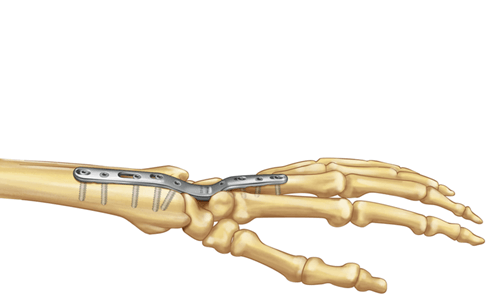
Common Types of Fusions:
- Wrist Fusion (Total Wrist Arthrodesis): Fuses the wrist bones to eliminate painful motion and restore stability
- Partial Wrist Fusion: Preserves some wrist movement while fusing selected bones
- Thumb (CMC Joint) Fusion: Stabilizes painful thumb base arthritis
- Finger Joint Fusion (PIP/DIP joints): Common for end-stage arthritis or deformity in fingers
Procedure Overview:
- Preoperative Evaluation: Includes physical examination and imaging (X-rays, CT scans) to plan the fusion position and technique.
- Surgery: The cartilage between bones is removed, and the bones are fixed together using plates, screws, wires, or pins until fusion (bone healing) occurs.
- Recovery: The wrist or hand is immobilized with a cast or splint. Fusion takes 6–12 weeks or longer depending on the joint and healing.
Do’s After Wrist & Hand Fusion
- Keep the hand elevated to reduce swelling
- Wear your splint or cast as directed
- Follow wound care and hygiene instructions carefully
- Start hand therapy when advised for surrounding joints
- Use assistive tools or adaptive grips during recovery
- Attend all follow-up visits and X-rays to monitor bone healing
Don’ts After Wrist & Hand Fusion
- Don’t use the operated hand for lifting or pushing until cleared
- Avoid wetting the surgical site or cast before healing
- Don’t smoke—smoking significantly delays bone healing
- Avoid ignoring signs of infection (fever, swelling, redness)
- Don’t skip physiotherapy for adjacent joints (like shoulder or fingers)