- Home
- About Us
- Orthopaedics / Joint Replacement
- Joint Replacement
- Sports Injury / Arthroscopy
- Trauma Fracture and Management
- Knee
- Hip
- Spine
- Shoulder & Humerus
- Elbow & Radius + Ulna
- Wrist & Hand
- Ankle & Foot Care
- Arthritis Management
- Paediatric Orthopaedics
- Pelvis & Acetabulum Fractures
- General Surgery
- Obstetrics & Gynaecology
- General Medicine
- Dermatology & Aesthetics
- ENT
- Contact Us

Total Shoulder Replacement
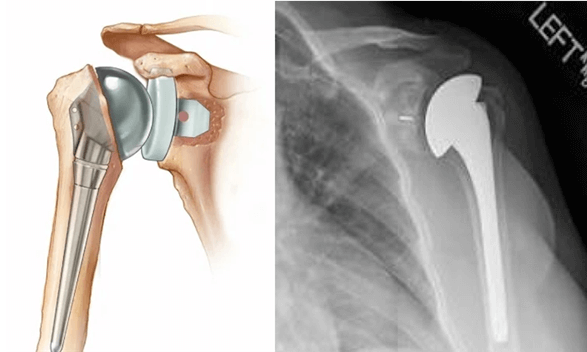
Total Shoulder Replacement, also known as Total Shoulder Arthroplasty (TSA), is a surgical procedure in which both the ball (humeral head) and the socket (glenoid) of the shoulder joint are replaced with artificial components. This procedure is designed to relieve chronic shoulder pain, restore joint function, and improve mobility—especially in patients with severe arthritis or irreparable joint damage.
It is one of the most effective treatments for end-stage shoulder arthritis, complex fractures, or degenerative joint diseases that do not respond to non-surgical treatment.
Who Needs Total Shoulder Replacement?
- Advanced osteoarthritis or rheumatoid arthritis
- Severe shoulder joint degeneration
- Complex or unrepairable fractures of the shoulder joint
- Failed previous shoulder surgeries
- Chronic shoulder pain and stiffness affecting daily life
Benefits of Total Shoulder Replacement:
- Significant pain relief
- Improved range of motion
- Enhanced strength and shoulder function
- Long-term joint stability
- Return to daily activities with greater comfort
Procedure Overview:
- Preoperative Evaluation: Includes physical examination and imaging (X-ray, MRI, or CT scan) to assess the joint and plan the surgery.
- Anesthesia: Performed under general or regional anesthesia.
- Surgical Process: The damaged humeral head is replaced with a metal ball attached to a stem, and the glenoid (socket) is resurfaced or replaced with a polyethylene (plastic) component.
- Closure & Recovery: The incision is closed and the arm is placed in a sling. Rehabilitation begins shortly after surgery to help restore shoulder movement and strength.
Do’s After Total Shoulder Replacement
- Wear your sling or immobilizer as directed
- Start gentle shoulder exercises under physiotherapist guidance
- Keep the surgical site clean and dry
- Follow up regularly for X-rays and healing assessment
- Take prescribed medications to manage pain and inflammation
- Maintain good posture and protect your shoulder from strain
Don’ts After Total Shoulder Replacement
- Avoid lifting heavy objects or sudden shoulder movements
- Don’t skip physiotherapy—it’s crucial for successful recovery
- Avoid driving or overhead activities until approved by your surgeon
- Do not soak the wound (no baths or swimming) until it is fully healed
- Don’t ignore signs of infection (fever, redness, discharge)