- Home
- About Us
- Orthopaedics / Joint Replacement
- Joint Replacement
- Sports Injury / Arthroscopy
- Trauma Fracture and Management
- Knee
- Hip
- Spine
- Shoulder & Humerus
- Elbow & Radius + Ulna
- Wrist & Hand
- Ankle & Foot Care
- Arthritis Management
- Paediatric Orthopaedics
- Pelvis & Acetabulum Fractures
- General Surgery
- Obstetrics & Gynaecology
- General Medicine
- Dermatology & Aesthetics
- ENT
- Contact Us
Reverse Shoulder Replacement
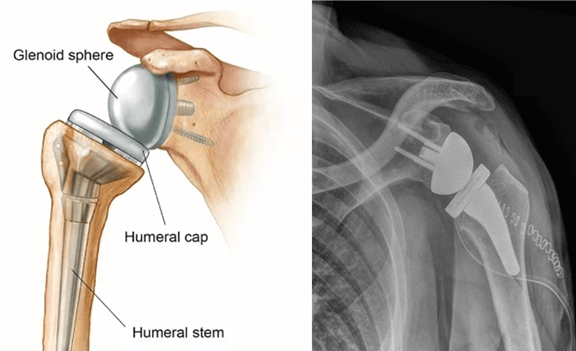
Reverse Shoulder Replacement is an advanced surgical procedure used to treat severe shoulder conditions, especially when the rotator cuff is badly damaged or irreparable. Unlike a traditional shoulder replacement, in a reverse shoulder arthroplasty, the ball and socket positions are reversed:
- A metal ball is placed on the shoulder blade (glenoid)
- A socket is placed on the upper arm bone (humerus)
This reverse design allows the deltoid muscle (rather than the damaged rotator cuff) to move the arm, restoring strength, mobility, and function.
Who Needs Reverse Shoulder Replacement?
- Massive, irreparable rotator cuff tears
- Rotator cuff tear arthropathy (arthritis with cuff damage)
- Failed previous shoulder replacements or surgeries
- Complex shoulder fractures (especially in elderly patients)
- Severe shoulder arthritis with muscle dysfunction
- Chronic shoulder dislocation or instability
Benefits of Reverse Shoulder Replacement:
- Restores arm movement and strength
- Reduces or eliminates chronic shoulder pain
- Effective even without a functioning rotator cuff
- Improves quality of life in severe or complex cases
- Reliable outcomes even in older or lower-demand patients
Procedure Overview:
- Pre-Surgery Assessment: Detailed imaging (X-rays, MRI, CT scans) helps plan implant size and placement.
- Anesthesia: Surgery is performed under general or regional anesthesia.
- Implant Placement: The surgeon removes the damaged parts of the shoulder and reverses the joint orientation:
- Metal ball on the shoulder blade
- Plastic socket on the arm bone
- Wound Closure & Recovery: The incision is closed and the arm is supported in a sling. Rehabilitation starts soon after, focusing on regaining strength and motion.
Do’s After Reverse Shoulder Replacement
- Wear a sling as instructed to protect the joint
- Begin physical therapy when advised to improve movement
- Keep the incision clean and dry
- Follow up regularly with your surgeon for healing checks
- Perform home exercises to maintain shoulder flexibility
- Eat a nutritious diet to aid recovery
Don’ts After Reverse Shoulder Replacement
- Do not lift or push anything heavy with the operated arm early on
- Avoid overhead or extreme shoulder movements until cleared
- Don’t ignore signs of infection (fever, drainage, redness)
- Avoid driving until your doctor permits
- Do not skip physiotherapy sessions or follow-up appointments