- Home
- About Us
- Orthopaedics / Joint Replacement
- Joint Replacement
- Sports Injury / Arthroscopy
- Trauma Fracture and Management
- Knee
- Hip
- Spine
- Shoulder & Humerus
- Elbow & Radius + Ulna
- Wrist & Hand
- Ankle & Foot Care
- Arthritis Management
- Paediatric Orthopaedics
- Pelvis & Acetabulum Fractures
- General Surgery
- Obstetrics & Gynaecology
- General Medicine
- Dermatology & Aesthetics
- ENT
- Contact Us

Fixation
Spinal fixation is a surgical procedure used to stabilize and support the spine after a fracture, often caused by trauma, osteoporosis, or tumors. When a vertebra is severely fractured and the spine becomes unstable, fixation is used to realign the spine, relieve nerve compression, and promote healing using implants like screws, rods, or plates.
Fixation can be performed alone or combined with decompression surgery if there is nerve involvement.
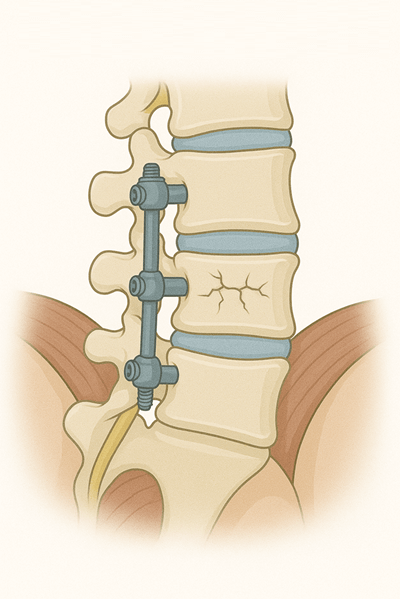
How the Procedure Works:
- Imaging (X-ray, CT, MRI) determines the exact site and severity of the fracture
- Under general anesthesia, a midline or minimally invasive incision is made
- Fractured vertebrae are realigned or stabilized
- Screws and rods are inserted into adjacent healthy vertebrae to secure the injured area
- In some cases, bone grafting or spinal fusion is performed to promote long-term stability
- The wound is closed and a brace may be applied postoperatively
Types of Fixation Used:
- Pedicle screw and rod system
- Anterior plating (for cervical fractures)
- Cages or interbody fusion devices
- Minimally invasive percutaneous screw fixation
Benefits of Spinal Fixation:
- Immediate spinal stability
- Prevents further collapse or deformity
- Reduces pain and nerve compression
- Restores spine alignment and mobility
- Allows for early mobilization and rehabilitation
Do’s After Spine Fixation
- Follow post-op instructions and wear a spinal brace if advised
- Begin gentle walking or movement early (as guided)
- Maintain good posture and spinal hygiene
- Attend all follow-ups and physiotherapy sessions
- Take medications as prescribed to manage pain and aid healing
Don’ts After Spine Fixation
- Avoid lifting heavy objects or sudden movements
- Do not bend or twist your back during the early recovery
- Avoid missing follow-up scans or X-rays
- Don’t smoke – it interferes with bone healing and fusion
- Avoid self-medicating or skipping prescribed exercises