- Home
- About Us
- Orthopaedics / Joint Replacement
- Joint Replacement
- Sports Injury / Arthroscopy
- Trauma Fracture and Management
- Knee
- Hip
- Spine
- Shoulder & Humerus
- Elbow & Radius + Ulna
- Wrist & Hand
- Ankle & Foot Care
- Arthritis Management
- Paediatric Orthopaedics
- Pelvis & Acetabulum Fractures
- General Surgery
- Obstetrics & Gynaecology
- General Medicine
- Dermatology & Aesthetics
- ENT
- Contact Us

Minimally Invasive / Endoscopic Decompression + Fixation
Cervical and lumbar spinal stenosis with arthritis is a common condition in which the spinal canal narrows due to age-related degeneration, disc bulges, or bone spurs, compressing the spinal cord or nerves. This leads to symptoms such as pain, numbness, weakness, and difficulty walking or using the arms.
When conservative treatments (like physiotherapy or medications) fail, Minimally Invasive or Endoscopic Decompression with Fixation provides a less traumatic surgical option to relieve pressure on the nerves and stabilize the spine—with smaller incisions, faster recovery, and fewer complications.
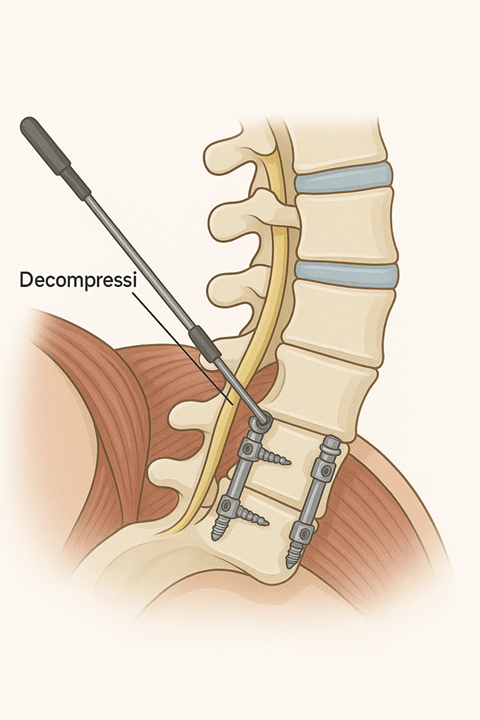
What is Minimally Invasive / Endoscopic Decompression + Fixation?
This procedure combines two key techniques:
- Minimally Invasive or Endoscopic Decompression: Uses a tiny camera and surgical tools inserted through small incisions to remove the structures (like herniated discs or bone spurs) compressing the nerves.
- Fixation (Spinal Fusion): Specialized screws, rods, or cages are inserted through the same small incisions to stabilize the affected spinal segment and promote bone fusion.
It can be performed on both the cervical (neck) and lumbar (lower back) regions of the spine.
Advantages of Minimally Invasive / Endoscopic Surgery:
- Very small incisions (1–2 cm)
- Less muscle and tissue damage
- Reduced post-operative pain
- Minimal blood loss
- Shorter hospital stay (often same-day or 24 hours)
- Faster return to daily activities
- Smaller scars and quicker wound healing
Do’s After Surgery
- Start walking or light movement as instructed
- Follow all post-op wound care and activity restrictions
- Wear a lumbar or cervical brace if recommended
- Take medications as prescribed
- Begin physiotherapy when advised
- Maintain good posture and back support
Don’ts After Surgery
- Avoid lifting heavy objects or bending forward early on
- Don’t ignore signs of infection (fever, redness, discharge)
- Avoid smoking—slows healing and affects spinal fusion
- Don’t skip follow-up appointments or rehab
- Avoid high-impact activities until fully recovered