- Home
- About Us
- Orthopaedics / Joint Replacement
- Joint Replacement
- Sports Injury / Arthroscopy
- Trauma Fracture and Management
- Knee
- Hip
- Spine
- Shoulder & Humerus
- Elbow & Radius + Ulna
- Wrist & Hand
- Ankle & Foot Care
- Arthritis Management
- Paediatric Orthopaedics
- Pelvis & Acetabulum Fractures
- General Surgery
- Obstetrics & Gynaecology
- General Medicine
- Dermatology & Aesthetics
- ENT
- Contact Us

Elbow – Fusion
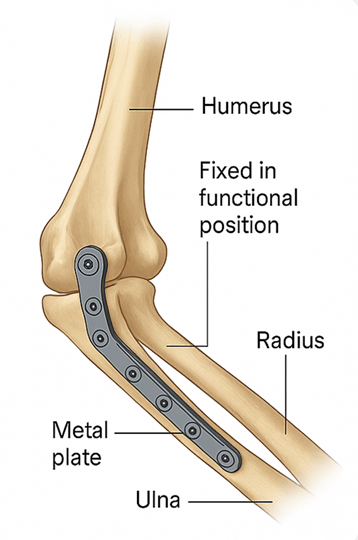
Elbow fusion, medically known as elbow arthrodesis, is a surgical procedure where the bones of the elbow joint (humerus, radius, and ulna) are permanently joined (fused) to eliminate motion in the joint. The goal of this procedure is to provide pain relief and joint stability in patients with severe elbow damage that cannot be treated with replacement or other methods.
While this surgery results in loss of elbow movement, it offers a strong and stable arm for essential activities, especially when pain relief is the primary goal.
When is Elbow Fusion Recommended?
- End-stage arthritis with severe pain and joint destruction
- Failed elbow joint replacements
- Chronic elbow infections (septic arthritis)
- Severe trauma with irreparable damage to bones, joints, or soft tissues
- Paralysis or neuromuscular conditions affecting elbow function
- Persistent instability that cannot be corrected with other surgeries
Procedure Overview:
- Preoperative Evaluation: Includes physical examination, imaging (X-rays/CT scans), and assessment of shoulder and wrist function to plan elbow position for fusion.
- Anesthesia: Surgery is performed under general or regional anesthesia.
- Fusion Surgery: Damaged joint surfaces are removed, and the bones are aligned in a fixed functional position (usually 90–110° of flexion). Metal plates, screws, or rods are used to hold the bones together until fusion occurs.
- Postoperative Recovery: The arm is immobilized in a splint or cast. Fusion typically takes 8–12 weeks. Physiotherapy may be needed for the wrist and shoulder.
Do’s After Elbow Fusion
- Keep the arm elevated to reduce swelling
- Follow wound care and immobilization instructions
- Maintain good hygiene and skin care around the splint or cast
- Perform exercises for the shoulder, wrist, and fingers
- Attend regular follow-ups and X-rays to monitor fusion progress
- Use adaptive devices for daily tasks (if needed)
Don’ts After Elbow Fusion
- Don’t lift or use the arm forcefully until fusion is confirmed
- Avoid activities that strain the fused joint
- Don’t get the surgical site wet or dirty until the wound heals
- Avoid smoking—it can delay bone healing
- Don’t ignore signs of infection or hardware issues