- Home
- About Us
- Orthopaedics / Joint Replacement
- Joint Replacement
- Sports Injury / Arthroscopy
- Trauma Fracture and Management
- Knee
- Hip
- Spine
- Shoulder & Humerus
- Elbow & Radius + Ulna
- Wrist & Hand
- Ankle & Foot Care
- Arthritis Management
- Paediatric Orthopaedics
- Pelvis & Acetabulum Fractures
- General Surgery
- Obstetrics & Gynaecology
- General Medicine
- Dermatology & Aesthetics
- ENT
- Contact Us

Arthroscopy
Shoulder arthroscopy is a minimally invasive surgical procedure used to diagnose and treat various conditions affecting the shoulder joint and surrounding soft tissues. Using a small camera (arthroscope) inserted through tiny incisions, the surgeon can view, diagnose, and repair joint damage with precision—often avoiding the need for large open surgery.
Arthroscopy is commonly used for rotator cuff tears, labral injuries, impingement syndrome, frozen shoulder, and shoulder instability. In some cases, it is also used to assist in the management of proximal humerus fractures.
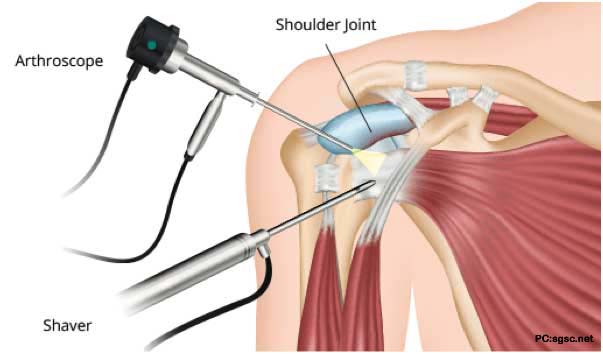
Common Indications for Shoulder Arthroscopy:
- Rotator cuff tear
- Recurrent shoulder dislocations
- Labral tear (SLAP lesion, Bankart lesion)
- Shoulder impingement syndrome
- Frozen shoulder (adhesive capsulitis)
- Loose bodies or cartilage damage
- Biceps tendon injuries
- Partial shoulder joint fractures
Procedure Overview:
- Evaluation & Imaging: Diagnosis is confirmed through clinical examination and imaging (MRI, X-ray, or ultrasound) before surgery.
- Anesthesia: The procedure is typically performed under general or regional anesthesia.
- Arthroscopic Surgery: Small incisions are made to insert the arthroscope and surgical tools. The surgeon visualizes the joint on a monitor and performs the necessary repairs—such as removing damaged tissue, repairing tears, or releasing tight structures.
- Closure & Recovery: The small incisions are closed with sutures or steri-strips. Most patients return home the same day and begin physiotherapy soon after.
Do’s After Shoulder Arthroscopy
- Use a shoulder sling as directed to support healing
- Keep the surgical area clean and dry
- Start physiotherapy as recommended to regain motion and strength
- Take prescribed medications to manage pain and inflammation
- Follow up with your orthopedic surgeon for wound check and recovery progress
- Perform home exercises as instructed
Don’ts After Shoulder Arthroscopy
- Avoid lifting, pushing, or overhead activities until cleared by your doctor
- Do not skip physiotherapy sessions
- Avoid getting the wound wet until sutures are removed and healing is complete
- Do not self-medicate or use shoulder braces without consulting your doctor
- Don’t ignore symptoms like swelling, fever, or increasing pain