- Home
- About Us
- Orthopaedics / Joint Replacement
- Joint Replacement
- Sports Injury / Arthroscopy
- Trauma Fracture and Management
- Knee
- Hip
- Spine
- Shoulder & Humerus
- Elbow & Radius + Ulna
- Wrist & Hand
- Ankle & Foot Care
- Arthritis Management
- Paediatric Orthopaedics
- Pelvis & Acetabulum Fractures
- General Surgery
- Obstetrics & Gynaecology
- General Medicine
- Dermatology & Aesthetics
- ENT
- Contact Us

External Fixators
External fixation is a surgical method used to stabilize severe fractures or complex bone injuries using a frame placed outside the body. It is especially useful in cases of open fractures, bone infections, multiple injuries, or severely damaged soft tissues where internal fixation (like plates or nails) may not be immediately suitable.
The technique involves placing metal pins or screws into the bone, which are then connected to an external frame to hold the broken bones in the correct position during healing.
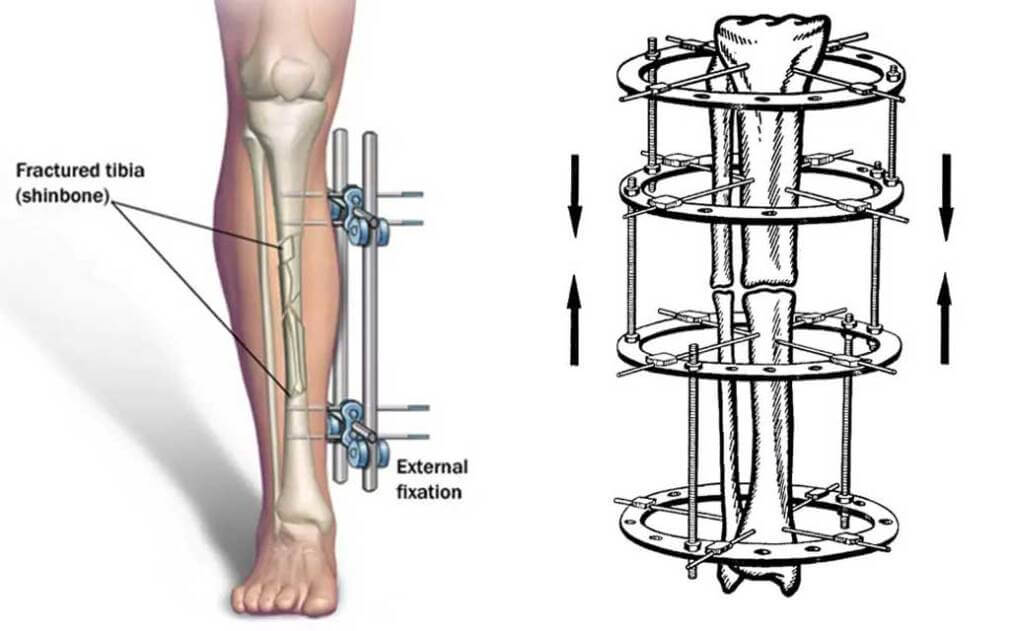
Procedure Overview:
- Evaluation and Planning: Imaging and clinical assessment are done to determine the extent of the fracture and soft tissue involvement.
- Anesthesia: The procedure is performed under local, regional, or general anesthesia depending on the injury.
- Pin Placement: Pins or wires are inserted into the bone above and below the fracture site through small skin incisions.
- Frame Application: The external frame is attached to the pins outside the body, securing the bones in proper alignment.
- Post-Operative Care: The external fixator remains in place until the bone heals, after which it is removed in a controlled setting. Wound care and regular pin site cleaning are essential.
Do’s After External Fixator Surgery
- Keep the pin sites clean and dry, following your doctor’s hygiene instructions.
- Attend all follow-up visits for X-rays and frame adjustment if needed.
- Follow weight-bearing restrictions as advised by your surgeon.
- Clean the frame daily to prevent infection.
- Notify your doctor of any signs of infection such as redness, swelling, pus, or fever.
- Participate in prescribed physiotherapy to maintain joint mobility.
Don’ts After External Fixator Surgery
- Do not twist, bump, or tamper with the fixator frame.
- Avoid submerging the fixator in water (no swimming or soaking in baths).
- Do not ignore pain or unusual discharge around pin sites.
- Avoid strenuous physical activities until cleared by your doctor.
- Don’t skip cleaning or dressing changes, as it increases the risk of infection.