- Home
- About Us
- Orthopaedics / Joint Replacement
- Joint Replacement
- Sports Injury / Arthroscopy
- Trauma Fracture and Management
- Knee
- Hip
- Spine
- Shoulder & Humerus
- Elbow & Radius + Ulna
- Wrist & Hand
- Ankle & Foot Care
- Arthritis Management
- Paediatric Orthopaedics
- Pelvis & Acetabulum Fractures
- General Surgery
- Obstetrics & Gynaecology
- General Medicine
- Dermatology & Aesthetics
- ENT
- Contact Us

Plating
Bone plating is a common orthopedic surgical technique used in the management of fractures. It involves the use of metal plates and screws to stabilize broken bones, ensuring proper alignment and promoting effective healing. This procedure is widely used for complex, displaced, or unstable fractures in various parts of the body, including the arm, leg, clavicle, pelvis, and facial bones.
Plating provides rigid fixation, which helps the bone heal in the correct position and allows early movement and rehabilitation.
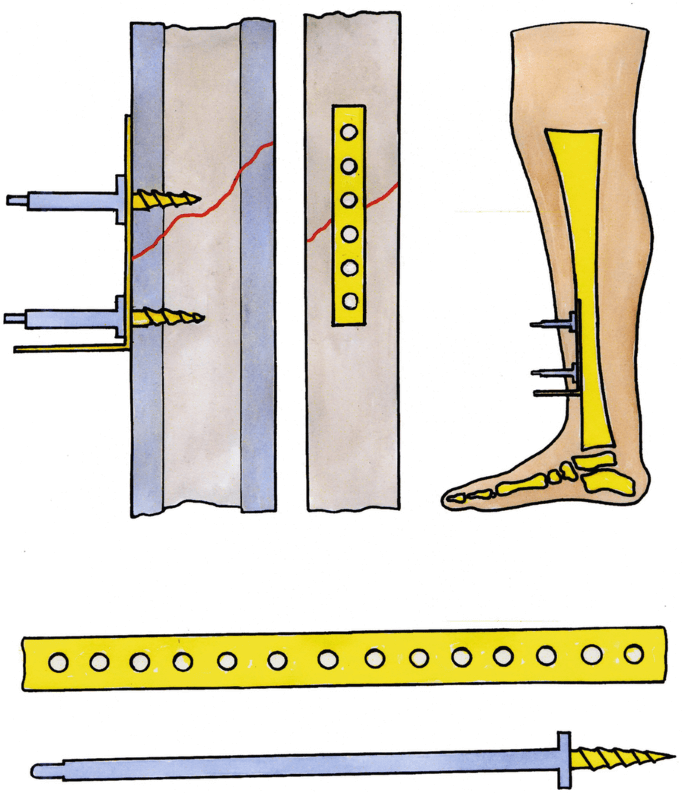
Procedure Overview:
- Assessment and Imaging: The orthopedic team conducts a thorough evaluation using X-rays, CT scans, or MRIs to assess the location, severity, and type of fracture.
- Anesthesia: The surgery is performed under general or regional anesthesia based on the injury site and patient health.
- Fracture Exposure and Reduction: A surgical incision is made to access the broken bone. The bone fragments are carefully realigned (reduced) to their natural position.
- Plate Fixation: A metal plate (usually made of titanium or stainless steel) is placed along the bone surface and fixed in place using surgical screws. This provides rigid support across the fracture.
- Closure and Recovery: The incision is closed with sutures, and a sterile dressing is applied. Postoperative rehabilitation starts as soon as it is safe, depending on the injury and bone involved.
Do’s After Bone Plating Surgery
- Follow your orthopedic surgeon’s advice on rest, mobility, and wound care.
- Keep the surgical site clean and dry to avoid infection.
- Attend scheduled follow-ups to monitor bone healing and plate stability.
- Follow your physiotherapy regimen to restore strength and mobility.
- Take all medications as prescribed, including pain relievers and antibiotics.
- Notify your doctor about any signs of infection, swelling, or increasing pain.
Don’ts After Bone Plating Surgery
- Do not lift heavy objects or put stress on the treated area too early.
- Avoid soaking the wound in water (no swimming or bathing) until fully healed.
- Do not skip physiotherapy sessions, as they are essential for functional recovery.
- Avoid smoking and alcohol, as they can slow down bone healing.
- Do not ignore abnormal symptoms, such as fever, excessive pain, or wound discharge.