- Home
- About Us
- Orthopaedics / Joint Replacement
- Joint Replacement
- Sports Injury / Arthroscopy
- Trauma Fracture and Management
- Knee
- Hip
- Spine
- Shoulder & Humerus
- Elbow & Radius + Ulna
- Wrist & Hand
- Ankle & Foot Care
- Arthritis Management
- Paediatric Orthopaedics
- Pelvis & Acetabulum Fractures
- General Surgery
- Obstetrics & Gynaecology
- General Medicine
- Dermatology & Aesthetics
- ENT
- Contact Us

Intramedullary (IM) Nailing
Intramedullary (IM) Nailing is a widely used orthopedic procedure for stabilizing fractures of long bones such as the femur (thigh bone), tibia (shin bone), and humerus (upper arm bone). This surgical technique involves inserting a metal rod (nail) into the central canal of the bone (medullary cavity) to maintain alignment and support the healing process.
IM nailing is especially effective for diaphyseal fractures (mid-shaft) and is considered the gold standard for long bone trauma due to its strength, minimal soft tissue disruption, and early mobilization benefits.
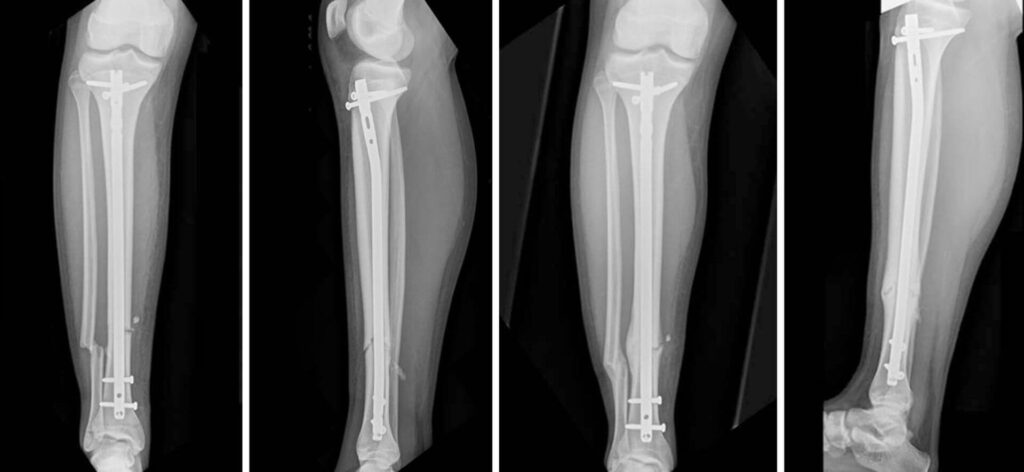
Procedure Overview
- Evaluation and Diagnosis:
Detailed imaging (X-ray, CT, or MRI) is performed to determine the fracture pattern and select the appropriate size and type of IM nail. - Anesthesia: The procedure is typically performed under general or regional anesthesia.
- Fracture Reduction and Nail Insertion: The bone is aligned correctly (reduced), and a metal nail is inserted into the bone canal through a small incision at one end of the bone. Locking screws are placed at both ends of the nail to secure it and maintain stability.
- Closure and Recovery: The incision is sutured, and early mobilization is encouraged in most cases. Rehabilitation is tailored to the fracture type and bone involved.
Do’s After IM Nailing Surgery
- Follow your surgeon’s post-op instructions carefully for activity, weight-bearing, and wound care.
- Attend follow-up appointments regularly for X-rays and recovery assessment.
- Keep the surgical site clean and dry to prevent infection.
- Start physiotherapy as advised to regain strength, flexibility, and function.
- Maintain a healthy diet rich in calcium, protein, and vitamin D for better bone healing.
- Report any unusual symptoms, such as redness, swelling, fever, or increased pain.
Don’ts After IM Nailing Surgery
- Do not bear full weight on the limb unless permitted by your surgeon.
- Avoid vigorous activities or sports until your doctor clears you.
- Do not skip physiotherapy sessions, which are vital for functional recovery.
- Do not get the surgical area wet until sutures/staples are removed and the wound has healed.
- Avoid smoking and alcohol, which can delay bone healing.