- Home
- About Us
- Orthopaedics / Joint Replacement
- Joint Replacement
- Sports Injury / Arthroscopy
- Trauma Fracture and Management
- Knee
- Hip
- Spine
- Shoulder & Humerus
- Elbow & Radius + Ulna
- Wrist & Hand
- Ankle & Foot Care
- Arthritis Management
- Paediatric Orthopaedics
- Pelvis & Acetabulum Fractures
- General Surgery
- Obstetrics & Gynaecology
- General Medicine
- Dermatology & Aesthetics
- ENT
- Contact Us

Kyphoplasty
Kyphoplasty is a minimally invasive surgical procedure used to treat spinal compression fractures, especially those caused by osteoporosis, trauma, or tumors. Similar to vertebroplasty, kyphoplasty also involves injecting bone cement into a fractured vertebra—but with an added step: a small balloon is inserted and inflated first to restore the height of the collapsed vertebra before stabilizing it with cement.
This procedure provides pain relief, helps restore spinal alignment, and improves posture and mobility.
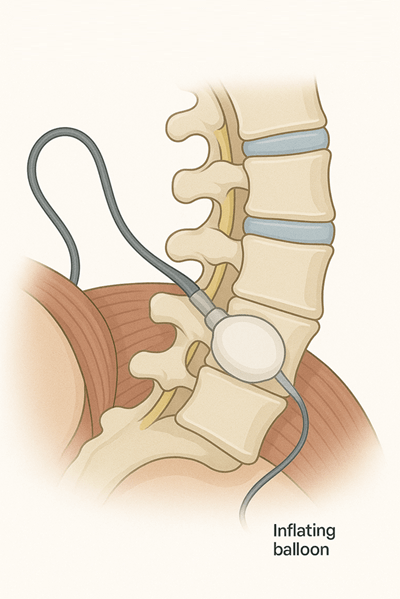
How the Procedure Works:
- Performed under local or general anesthesia
- A hollow needle is inserted into the fractured vertebra using X-ray guidance
- A small balloon is inserted and gently inflated to create space and restore height
- Once the balloon is removed, the space is filled with medical-grade bone cement
- The cement hardens quickly, stabilizing the vertebra
- The entire procedure usually takes 30 to 60 minutes per level, and most patients can return home the same day or next morning.
Benefits of Kyphoplasty:
- Immediate and lasting pain relief
- Restores height and reduces spinal deformity
- Minimally invasive with small skin incisions
- Quick recovery—most patients resume daily activities within a few days
- Reduces risk of further vertebral collapse
- Improves posture and breathing in some cases
Do’s After Kyphoplasty
- Resume walking and light activities as advised
- Follow instructions for wound care and medications
- Practice good posture and back hygiene
- Begin bone-strengthening exercises (as recommended)
- Continue treatment for osteoporosis or underlying bone conditions
Don’ts After Kyphoplasty
- Avoid lifting heavy objects for at least 2–4 weeks
- Do not bend or twist your spine sharply
- Don’t ignore any new pain, numbness, or weakness
- Avoid missing follow-up
- appointments or bone health assessments
- Do not smoke—this slows down bone healing