- Home
- About Us
- Orthopaedics / Joint Replacement
- Joint Replacement
- Sports Injury / Arthroscopy
- Trauma Fracture and Management
- Knee
- Hip
- Spine
- Shoulder & Humerus
- Elbow & Radius + Ulna
- Wrist & Hand
- Ankle & Foot Care
- Arthritis Management
- Paediatric Orthopaedics
- Pelvis & Acetabulum Fractures
- General Surgery
- Obstetrics & Gynaecology
- General Medicine
- Dermatology & Aesthetics
- ENT
- Contact Us

Open Decompression + Fixation
Cervical and lumbar spinal stenosis, often caused by arthritis or age-related degeneration, leads to narrowing of the spinal canal and compression of the spinal cord or nerves. When symptoms like chronic pain, numbness, weakness, or walking difficulty are severe and non-surgical treatments fail, a surgical procedure called Open Decompression with Fixation may be recommended.
This surgery combines nerve decompression to relieve pressure and spinal fixation (fusion) to stabilize the affected segment of the spine.
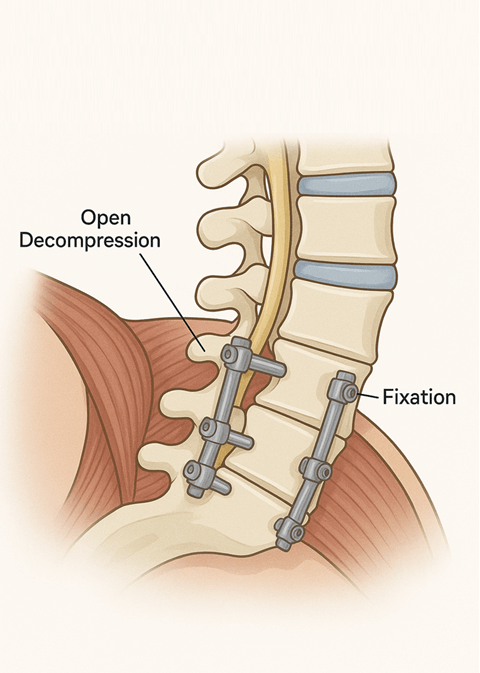
What Is Open Decompression + Fixation?
- Open Decompression involves surgically removing bone, disc material, or thickened ligaments that are compressing the nerves or spinal cord (e.g., laminectomy, discectomy, foraminotomy)
- Fixation involves placing screws, rods, or cages to stabilize the spine, correct alignment, and support healing by promoting bone fusion between the affected vertebrae.
Procedure Overview:
- Anesthesia & Positioning: The patient is given general anesthesia and positioned depending on the spine level involved.
- Open Access: A midline incision is made over the affected spine region.
- Decompression: The surgeon removes part of the vertebra (lamina), disc, or bone spurs to relieve nerve pressure.
- Fixation: Screws, rods, or cages are inserted to stabilize the spine and support bone fusion.
- Closure & Recovery: The incision is closed, and the patient is moved to recovery with a post-operative care plan.
Do’s After Open Decompression + Fixation
- Follow wound care and medication guidelines
- Start gentle walking and mobility as advised
- Wear spinal support (brace) if prescribed
- Perform physiotherapy and rehabilitation exercises
- Maintain good posture and spinal hygiene
Don’ts After Surgery
- Avoid bending, lifting, or twisting in the early recovery phase
- Don’t skip physiotherapy or follow-up visits
- Avoid sitting or standing for long durations without breaks
- Don’t ignore signs of infection (fever, swelling, discharge)
- Avoid smoking—it delays bone healing and fusion