- Home
- About Us
- Orthopaedics / Joint Replacement
- Joint Replacement
- Sports Injury / Arthroscopy
- Trauma Fracture and Management
- Knee
- Hip
- Spine
- Shoulder & Humerus
- Elbow & Radius + Ulna
- Wrist & Hand
- Ankle & Foot Care
- Arthritis Management
- Paediatric Orthopaedics
- Pelvis & Acetabulum Fractures
- General Surgery
- Obstetrics & Gynaecology
- General Medicine
- Dermatology & Aesthetics
- ENT
- Contact Us

Minimally Invasive Decompression
Minimally Invasive Decompression is a surgical technique used to relieve pressure on spinal nerves caused by conditions like herniated discs, spinal stenosis, or bone spurs. Unlike traditional open surgery, this method uses small incisions, specialized tools, and often a tubular retractor to access and treat the affected area with minimal damage to surrounding muscles and tissues.
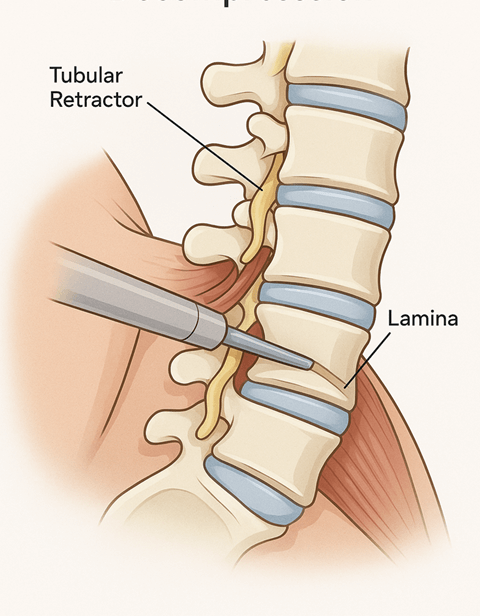
Benefits of Minimally Invasive Decompression:
- Smaller incision with minimal tissue disruption
- Less blood loss and scarring
- Lower risk of infection
Reduced post-operative pain - Shorter hospital stay
- Faster recovery and return to daily activities
Procedure Overview:
- Preoperative Imaging (MRI or CT) to locate the compression
- Small incision made over the target spinal level
- Tubular retractor used to gently separate muscles
- Microscope or endoscope guides the surgeon
- Lamina, disc material, or bone spurs removed to relieve nerve pressure
- Incision closed with sutures or surgical glue
Do’s After Surgery
- Walk and move gently as soon as advised
- Follow wound care instructions
- Perform light exercises or stretches as guided
- Take medications as prescribed
- Attend scheduled follow-ups and physiotherapy (if recommended)
Don’ts After Surgery
- Avoid lifting heavy weights
- Don’t bend, twist, or strain your back early on
- Don’t skip medications or ignore post-op instructions
- Avoid prolonged sitting or standing initially
- Don’t resume intense activities without medical clearance